ANCESTRAL HOUSE
by
Mama Satela
Discreet work for complex personal and spiritual matters.
Confidential · By request only


My background
I am known as Mama Satela, a name connected to my spiritual work and the responsibilities I carry. My path did not begin with a title, an initiation or a decision made later in life to turn spirituality into a profession. It began within my family, among women who carried old knowledge and passed it directly from one generation to the next—from mother to daughter, from grandmother to granddaughter, and from the women who came before them to those entrusted with carrying the knowledge forward.
The oldest and most important foundation of my work is hereditary. I was raised within the Central European and Slavic spiritual traditions of my family, where knowledge was not separated from ancestry, family or daily life. Herbs, protection, cleansing, communication with spirits, work with the dead and the old methods used to recognize and approach difficult spiritual conditions were already part of my world when I was a child.
This knowledge did not originate with one person, nor was it assembled from books. It represents centuries of accumulated experience: practices repeated across generations, methods preserved because they worked, warnings remembered because something should not be repeated, and an understanding of what may be approached, what must be handled carefully and what should be left untouched. What passed through my family was not simply a collection of instructions. It was practical judgment developed through generations of observation, spiritual responsibility and direct experience.
The ancestors stand at the center of this tradition. The dead do not cease to belong to the family, and the living do not work alone. Ancestors may protect, guide, warn, open a path, reveal the source of a problem or demand that something unfinished be addressed. Working with the dead therefore requires more than knowing the words of a ceremony. It requires an established relationship, the ability to recognize which spirit is present, an understanding of what is being asked and the judgment to know when contact should—or should not—be pursued.
I began learning by watching, listening and being present. I learned that two situations that appear identical may have entirely different roots and cannot be handled with the same method. I learned that a practice cannot be executed like a recipe simply because its steps have been written down. The spirits involved, the history of the condition, the person seeking help and the objective of the work all affect how the matter must be approached.
This ancestral foundation is also what allowed me to recognize something deeply familiar when my path led me into Haitian Vodou. The two traditions are historically, culturally and spiritually distinct. They have different spirits, languages, ceremonies, laws and forms of service. Yet beneath those differences lies a truth I had known since childhood: the living remain connected to the ancestors and the dead, spiritual work depends upon real relationships with spirits, and knowledge carries obligations.
Haitian Vodou did not give me my first spiritual identity and did not replace the tradition of my family. It introduced me to another complete spiritual world and gave me access to knowledge that can only be received from within that tradition. I entered Vodou because proper entry is required to receive its internal knowledge, develop relationships with its spirits and accept the responsibilities that accompany them. Initiation gave me a rightful place within that tradition; it did not create or replace the spiritual identity I already carried.
I therefore bring two different but deeply resonant worlds to my work: the hereditary knowledge of my Central European and Slavic family, and almost twenty years of lived practice and service within Haitian Vodou. I preserve the identity and integrity of each tradition, understanding where they correspond, where they may work together and where they must remain entirely separate. I know where each tradition begins and ends, which spirits belong to which spiritual world and which obligations must be respected.
There are situations in which knowledge from both foundations may contribute to the work, situations in which only one tradition is appropriate and situations in which the two must remain entirely separate. Knowing the difference is part of the experience I bring to every case.
I do not simply reproduce a ceremony step by step as though following a written formula. I examine the root of the condition, the people involved, the surrounding spiritual relationships and the objective that must be addressed. I work with spirits rather than presenting the external appearance of spiritual work. The method is selected and prepared in response to the actual case, with an understanding of what can be used, what should not be combined and what must not be touched at all.
What distinguishes my work is the depth and range of knowledge behind it: hereditary teaching transmitted through generations, a lifelong relationship with ancestors and the dead, and almost twenty years of lived practice within Haitian Vodou.
I am a published author, folklorist and researcher of spiritual traditions. My research is inseparable from practice because I write about worlds I have entered through family knowledge, oral teaching, initiation, ceremonies, travel, fieldwork and personal relationships. My understanding comes from direct participation as well as serious study, and from relationships with the people whose lives continue to carry these traditions forward.
My published work examines the relationship between human beings, ancestors, spirits, ritual practice and the old knowledge preserved within families and communities. Writing allows me to document parts of these worlds while respecting the responsibilities, boundaries and confidences that accompany direct participation. Not everything that is known should be made public. Preserving a tradition also requires understanding what may be shared, what belongs within a lineage and what must remain protected.


A Documented Spiritual Path
My path did not begin when I created a website. It can be followed through my published books, research, photographs, videos, ceremonies, travels and many years of public work. My life has taken me between the United States, Europe, Haiti and other parts of the Caribbean, bringing me into direct contact with the people, places and living traditions that have shaped my understanding.
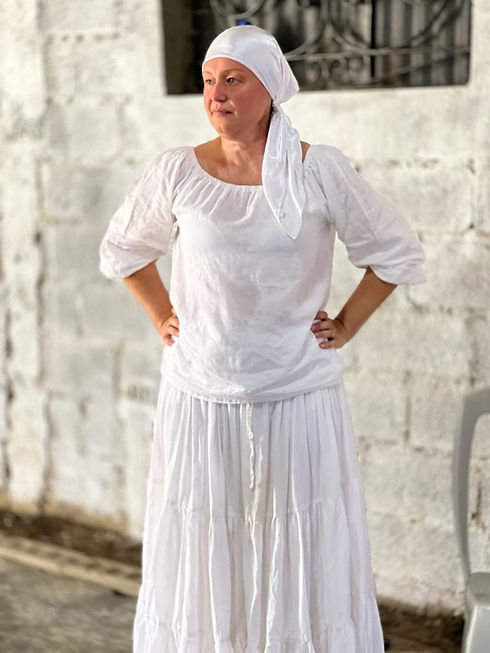
The photographs and videos presented on this website come from my personal archive. They are not stock images selected to create a spiritual appearance. I am the person shown in them, within the actual places, ceremonies and experiences that form part of my life.
My identity, face, writing and professional history are public because anyone considering private spiritual work should be able to know who stands behind the name. You can see the person, the published work and the documented path behind Mama Satela.
Why I Am Called Mama
People call me Mama because I listen, I care about what happens after someone places their trust in me, and I understand the weight of becoming involved in another human being’s life. Spiritual responsibility does not end when a ceremony is completed. It continues in how the matter is handled, how the person is treated and how the obligations created by the work are respected.
When someone contacts me, they communicate directly with me. I personally read every inquiry, examine the situation, decide whether I can accept it and perform any work I agree to undertake.
If you would like me to consider your situation, you may write to me privately. All communication is handled with discretion.